
Cars
🚗
x
1
Passengers
🧑
x
2
Children included
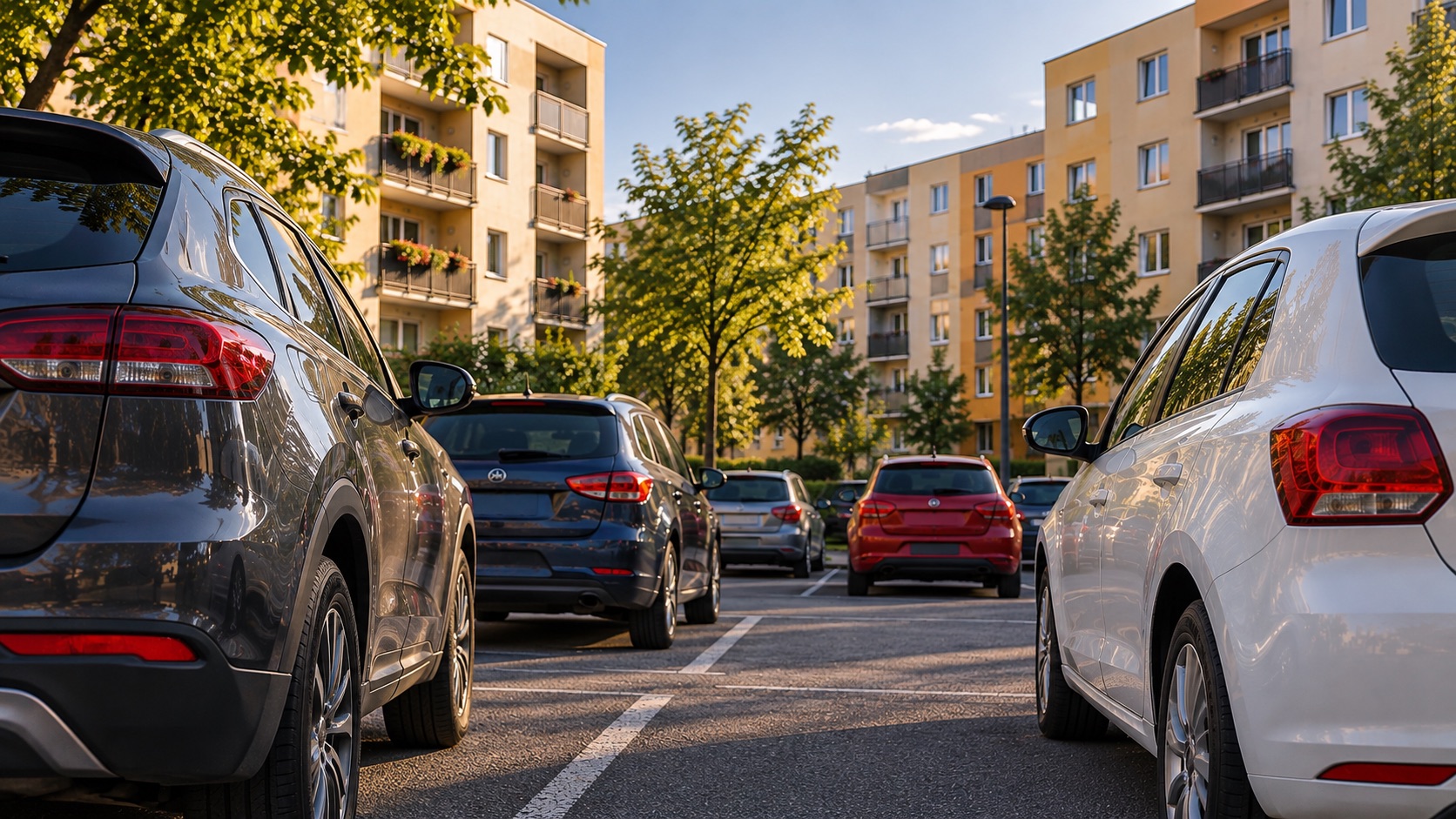
Around Budapest's Liszt Ferenc Airport the same tip has circulated on travel forums for years: a few kilometres before the terminals, on the housing estate in Vecsés, there is free street parking, you can leave the car there for a week, and from there it is only a bus ride. That option is now visibly coming to an end. The municipality of Vecsés has presented a parking concept at a public forum whose stated aim is to give the estate's spaces back to the people who live there.
The summary after the forum was delivered by Mayor Csaba Szlahó, on video: his statement can be watched here (in Hungarian). What follows largely tracks his words.
The figures given at the forum are unambiguous: over the past three years the number of cars parked on the estate has grown by roughly twenty-five percent, and occupancy has reached one hundred percent. For most of the working week, in other words, there is simply no free space.
According to the mayor, those spaces are not mainly taken by residents. He named four groups:
“Let us filter out those who do not belong here” – this is how the mayor summed up the logic. “Let us clear out these free riders, and then we will see how many spaces there are, and only after that can every other measure follow.” The concept is therefore deliberately a first step, not a final solution: first it becomes clear how much space is freed up, and the remaining decisions come afterwards.
According to the draft presented at the public forum, the system rests on two pillars: registration for residents and disc parking for visitors.
The fee for the second car drew the most objections. The mayor's reasoning is simple: the number of available spaces is finite, and a household parking two cars on public land takes up twice as much of it – so the system encourages anyone with a garage or an underground parking space to use it.
A recurring question at the forum was whether this is really about revenue. The mayor rejected that firmly: in his account the system will cost the town money, because extra staff have to be hired for enforcement, the area has to be signposted, and the technical background has to be built.
Beyond that, the estate's public areas – the car parks, the green spaces, the playground – continue to be maintained by the town, and the traffic measures raised at the forum (speed bumps, mirrors, repainted road markings) are also paid for by the municipality. “This cannot be read through that profit-driven lens” – the mayor said. “The point is that there should be order, and that there should be parking on the estate as well.”
Car sharing was a topic of its own. Before the forum a claim had been going around that the municipality had a contract with one of the car-sharing companies. According to the mayor this is false information: they have never signed such an agreement with anyone. Years ago one company did approach them about renting parking space, but with no parking regulation in force they could not rent anything out, and the company has not been heard from since.
What did happen: the car-sharing operators marked the estate as free parking on their own maps, and there were periods when twenty of their cars stood there at once. The municipality first asked MOL Limo to remove the vehicles; today it warns and fines the company, and does the same with GreenGo's cars.
The mayor drew a distinction here: a resident occasionally coming home in a shared car is a different matter from fifteen or twenty vehicles parked long-term on the estate. With the rental firms the complaint is not only the space they take up, but also the mess left around the returned cars.
Not tomorrow. The order of events, according to the mayor, is this: the residents' suggestions are built into the draft, the regulation is adopted, the enforcement staff are put in place, the area is signposted – and only then does it go live.
In practice that means the first half of next year, around February, with a three-month trial period. During the trial the emphasis is on warnings; real enforcement starts only afterwards. Anyone travelling in the coming months will still find the old situation – but by the 2027 summer season the system will be up and running.
It means that the options for “free parking” around Ferihegy keep narrowing. A space on the estate's streets was never guaranteed in the first place; from now on the disc bays will allow an hour, and in the residential zone nothing will be legal without registration – least of all for the length of a week's holiday. From next spring, leaving the car there will not be a saving but a risk of a fine.
It is worth reading this together with what has already been said about parking on the hard shoulder and along the ditch: free airport parking rarely costs nothing. There the risk is an unattended car, here it is the regulation – in both cases the result is that the least predictable part of the trip turns out to be the one thing that should be the most predictable: where your car is while you are away.
A guarded car park with cameras is, by contrast, a known quantity: you have a guaranteed space, you know what it costs, and the transfer takes you to the terminal. You can compare the prices and services of the car parks near the airport in a few minutes:
The full range is laid out in one table in the comparison of Budapest airport car parks.
Source: statement by Mayor Csaba Szlahó on the Vecsés public forum, 18 September 2026 – video on Facebook (in Hungarian).