Cars
🚗
x
1
Passengers
🧑
x
2
Children included

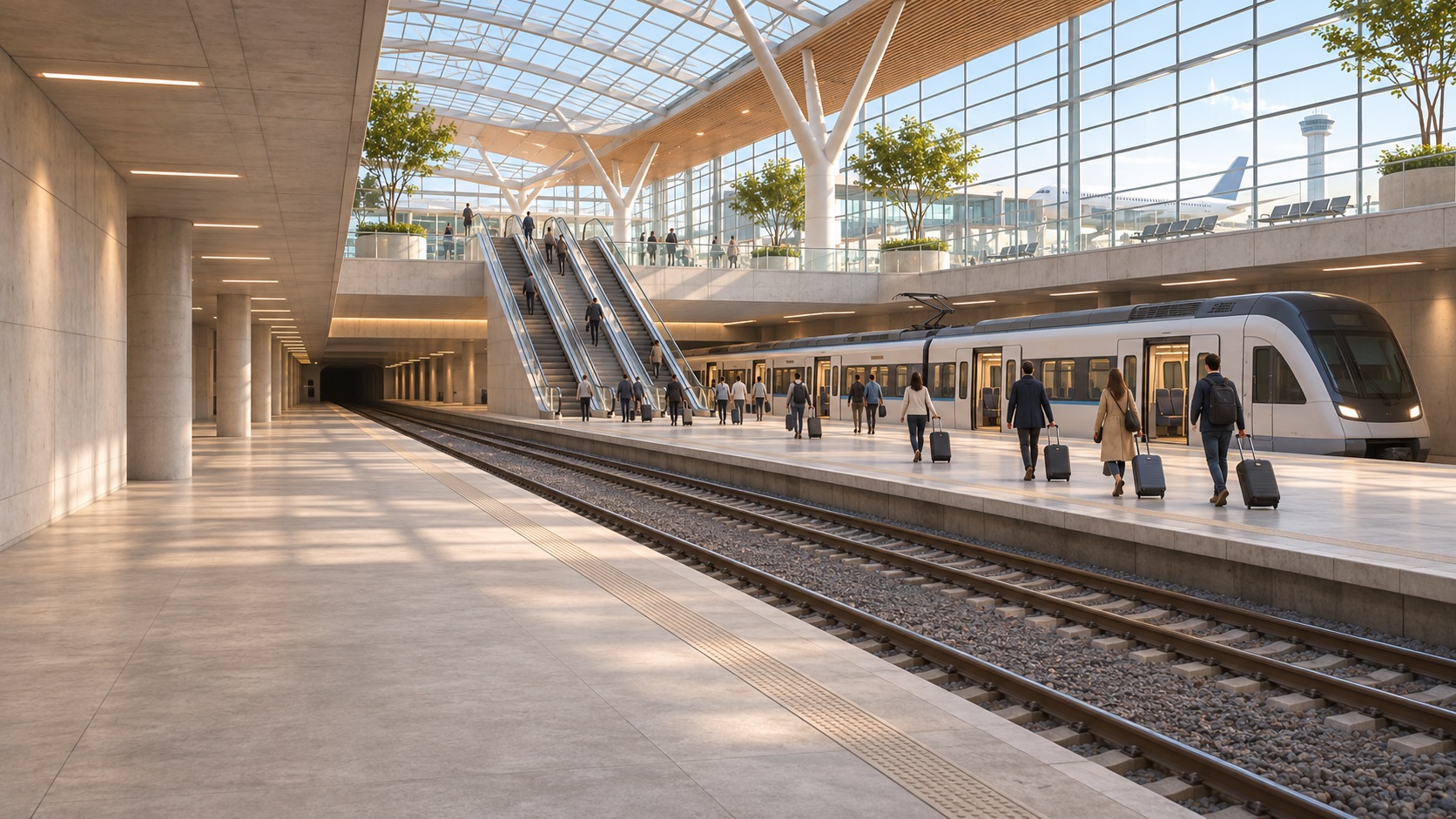
The first half of November brought a run of news about how people will get to Budapest Liszt Ferenc International Airport. The item that matters most for drivers is that the government has restarted the widening of the expressway leading to the airport. A day later, some details of the airport railway emerged too, and new buses are already running on the 100E. The big projects, however, are still only plans: work on the road could start in 2028 at the earliest, and no concrete date has been given for the railway. Based on BUDstart's reports, we have summarised what to expect over the coming years.
On 11 November, Dávid Vitézy, Hungary's Minister for Transport and Investment, announced in a video that the government is restarting the reconstruction of the expressway to the airport. The project has been on the agenda for more than ten years but has never got under way. The government decree appeared in the official gazette, Magyar Közlöny, the same evening, and the permitting procedure for the existing designs is starting now. BUDstart's article has the details.
According to the plans:
The designs also have to take the airport railway into account. Its new tracks would branch off at Csévéző utca, where the railway crosses the expressway, so the plans for the two projects need to be coordinated.
On the existing expressway, a single accident or breakdown can close the road completely, and when that happens everyone heading to or from the airport, as well as commuters from the surrounding towns, is stuck. Anyone who leaves the airport on the 100E or 200E bus, by taxi or by car meets Budapest on this road first. "We are not showing our best face," said Dávid Vitézy – and he has a point: in places the road has more potholes than intact asphalt.
For drivers this matters twice over. Most of the car parks around the airport are close to this road and to Üllői út: the way to the car park runs along it, and the car park's transfer to the terminal usually uses it as well. An accident therefore slows down not only taxis and buses, but also anyone setting off from a car park to the terminal.
Not straight away. Before the contractor can begin, the state has to expropriate more than 300 properties under the procedure laid down by law. According to the minister's announcement, the construction tender is expected in the second half of 2027, preparatory work could begin in 2028 at the earliest, and the main construction in 2029. At a press conference the following day he said that work could begin in the second half of 2028 at best, or in 2029 at a slower pace, and that it would proceed section by section so that not all the restrictions come into force at once.
When the new road will be finished, and how traffic will flow during construction, is not yet known.
The government decree sets out the tasks for the next two years. The government continues to treat better road access to the airport as a priority investment, the land acquisition already under way will continue, and within 90 days of the detailed designs being completed, a conditional public procurement must be launched to select the contractor. Up to HUF 8 billion is set aside for land acquisition and site preparation in 2027, and up to HUF 16.47 billion in 2028. The total cost of construction will be decided once the bid prices are known; at the press conference the minister put it at between HUF 100 and 200 billion.
On 12 November, the minister and Budapest's mayor, Gergely Karácsony, signed the agreement that turns BKK, Budapest's public transport authority, into a regional one, and the airport railway also came up at the press conference. The government supports the option in which trains do not turn back at the airport but continue onwards; this design has a valid permit from the railway authority.
From Kőbánya-Kispest there would be four tracks instead of today's two. The new line would run between the airport's two runways, with an underground station in front of Terminal 2, from which both the terminal and the new terminal building planned there could be reached on foot along a fully enclosed route. From there the line would continue under the M0 ring road, bypass Vecsés and Monor, and join the main line to Szolnok beyond Monor.
InterCity and InterRégió trains from Debrecen, Nyíregyháza, Szeged, Kecskemét and Cegléd would stop at the airport and continue via Zugló to Nyugati railway station. Trains from Győr, Tatabánya and Székesfehérvár, coming through Kelenföld, would reach the airport via new stops on the southern circular railway – Nádorkert, Közvágóhíd and Népliget – at least every half hour. That, however, also needs the southern circular railway, whose construction contract the ministry has suspended; in the most optimistic scenario, a new contractor could be in place by early 2028.
A concession tender is under way for the project, which runs to several hundred billion forints, and the bidding stage starts in early 2027. "In procurement terms, the railway is further ahead than the road," said Dávid Vitézy. Nothing was said about when construction could start, when the first trains might run, or about timetables and fares.
One change is already visible: since 2 November, new articulated buses have been running on the 100E, the express between the airport and the city centre. BKK is putting 24 of them into service, each with a luggage rack in front of the second door that holds 15–25 suitcases, depending on their size.
From 1 January 2027, BKK will be owned half by the state and half by the city, and it will also order the HÉV suburban railway lines and the Volánbusz routes that start in Budapest and stay within Pest County. The aim is for buses in the nearby suburbs to run more often in the evenings and at weekends too, and for one ticket to be enough instead of today's three types. When this will happen, and at what price, is not yet known, and the 100E and 200E were not discussed at the press conference.
Work on the road could start in 2028 at the earliest, there is no date yet for the railway, and neither project has a completion date. Until then, you get to the airport on today's road and today's buses. If you are driving, it is worth booking your parking in advance: on ParkoLow you can compare the prices of the car parks around the airport, their distance from the terminal and guest reviews in a single search.
Bookings can be cancelled free of charge, and you only pay on site. You can also browse the full range in our comparison of Budapest airport car parks.
Sources: BUDstart's transport articles published between 4 and 13 November 2026; the video of 11 November and the press conference of 12 November by Dávid Vitézy, Minister for Transport and Investment; BKK; Magyar Közút.